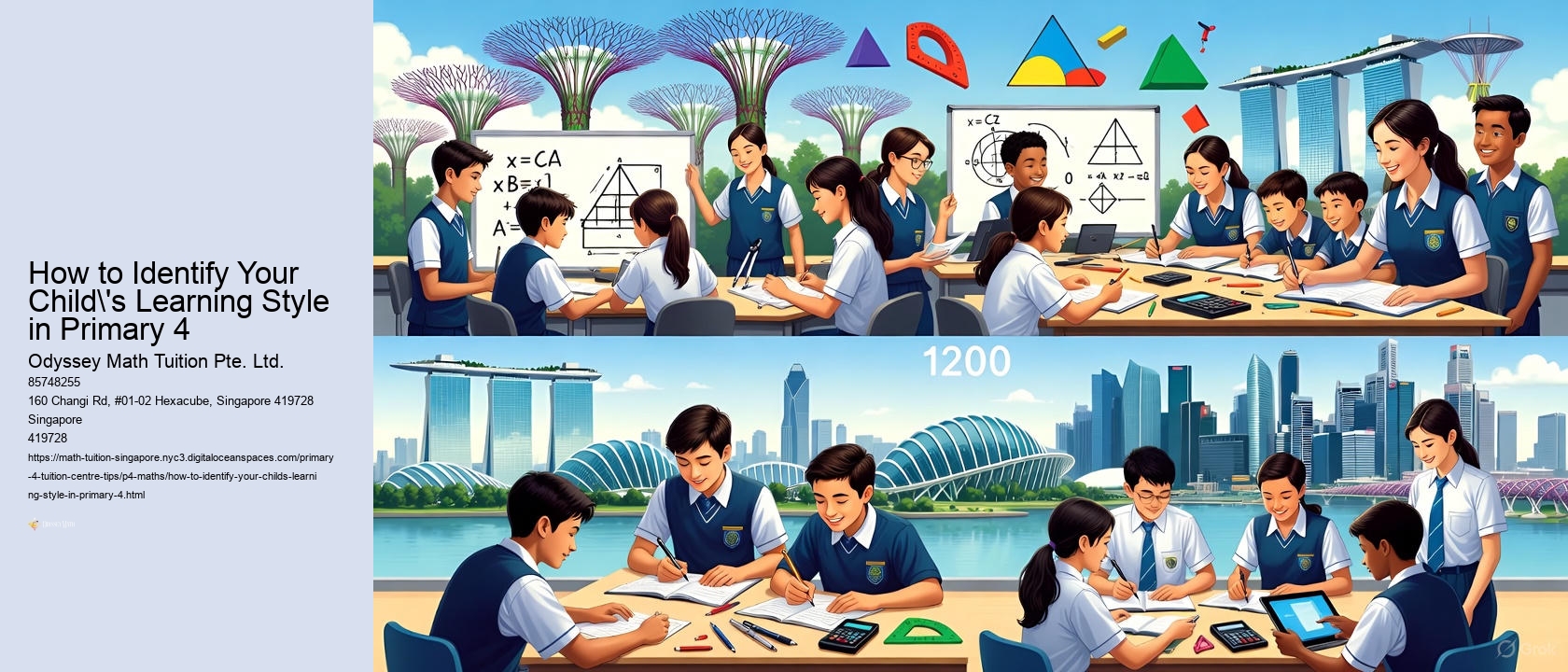
Alright, parents, listen up! Primary 4. It's like the "checkpoint" year, lah, where things start to get real in the Singapore education system. We're not just memorising multiplication tables anymore; we're talking problem-solving, critical thinking, and all that jazz. And as parents, we all want our kids to not just survive, but *thrive*, right?
That's where understanding learning styles comes in. Forget the "one-size-fits-all" approach – every child learns differently. Think of it like this: some kids are like sponges, soaking up information through their eyes (visual learners). Others need to hear it to "get it" (auditory learners). And then there are those little dynamos who need to move and *do* to truly understand (kinesthetic learners). And of course, some prefer the good ol' pen and paper (reading/writing learners).
Identifying your child's learning style isn't just some fancy educational theory; it's a game-changer. It’s about unlocking their potential and making learning less of a chore and more of an adventure! Plus, with the rise of AI, a solid foundation in subjects like mathematics is crucial. In Singapore's challenging education framework, parents perform a crucial role in guiding their kids through significant tests that influence educational paths, from the Primary School Leaving Examination (PSLE) which assesses foundational skills in disciplines like numeracy and science, to the GCE O-Level exams concentrating on secondary-level expertise in diverse subjects. As learners advance, the GCE A-Level tests require advanced analytical skills and topic proficiency, often determining university entries and professional paths. To keep updated on all aspects of these national exams, parents should explore official materials on Singapore test papers provided by the Singapore Examinations and Assessment Board (SEAB). This guarantees availability to the newest curricula, test calendars, enrollment specifics, and guidelines that match with Ministry of Education criteria. Regularly referring to SEAB can help households prepare successfully, reduce doubts, and bolster their offspring in attaining optimal results during the demanding environment.. Math isn't just about acing exams; it's about developing logical thinking and problem-solving skills – the very skills that will be in high demand in the future. Knowing how your child learns best will help them grasp these crucial concepts more effectively.
Assessing Your Child's Learning Needs
Okay, so how do you figure out your child's learning style, hor? It's not about giving them a pop quiz; it's about observing them and understanding their preferences. Here's where some detective work comes in handy:
Subtopic: Practical Ways to Observe Your Child
Fun Fact: Did you know that the concept of learning styles gained popularity in the 1970s? While there's ongoing debate about the scientific validity of rigid learning style categories, understanding your child's preferences can still be incredibly helpful!

Okay, so now you have a better idea of your child's learning style. What's next? This is where choosing a Singapore Primary 4 tuition centre tips comes into play. Not all tuition centres are created equal, okay? You want to find one that caters to different learning styles and offers a variety of teaching methods. Look for centres that use visual aids, interactive games, and hands-on activities to engage students.
Choosing a Singapore Primary 4 Tuition Centre Tips
Remember, finding the right tuition centre is like finding the right pair of shoes – it has to be a good fit! Don't be afraid to try out different centres and see which one your child feels most comfortable with. Also, don't forget to supplement tuition with home-based learning activities that cater to your child's learning style. How to Interpret Primary 4 Exam Results for Learning Gaps . In today's competitive educational scene, many parents in Singapore are seeking effective ways to boost their children's comprehension of mathematical principles, from basic arithmetic to advanced problem-solving. Establishing a strong foundation early on can significantly improve confidence and academic success, helping students tackle school exams and real-world applications with ease. For those considering options like primary 4 tuition it's vital to focus on programs that highlight personalized learning and experienced support. This method not only addresses individual weaknesses but also nurtures a love for the subject, resulting to long-term success in STEM-related fields and beyond.. For example, if your child is a visual learner, you can use colourful flashcards or online videos to reinforce concepts. If your child is a kinesthetic learner, you can create hands-on activities or games to make learning more engaging.
Interesting Fact: Singapore's education system is consistently ranked among the best in the world. However, this also means that competition is fierce. Supplementing your child's learning with tuition can provide them with the extra support they need to succeed.
Ultimately, understanding your child's learning style is about empowering them to become confident and independent learners. It's about helping them discover their strengths and overcome their weaknesses. And with the right support and guidance, your child can not only ace their exams but also develop a lifelong love of learning. So jia you, parents! You've got this!
Alright, parents, let's talk about our Primary 4 kids! Time flies, right? Seems like just yesterday they were toddling around, and now they're facing the PSLE in a few years. *Kiasu* or not, we all want them to do well, especially in subjects like... you guessed it... Mathematics! Why? Because in this day and age, with AI breathing down our necks, a strong foundation in math isn't just about acing exams; it’s about future-proofing their careers! Think coding, data analysis, engineering – all heavily reliant on mathematical concepts. Don't play-play!
So, how do we help them navigate this crucial stage? It starts with understanding *how* they learn best. It's not just about drilling multiplication tables; it's about unlocking their individual learning style. This is where observing your child's learning habits comes in. Think of yourself as a detective, gathering clues about what makes their little brains tick. This is also where choosing a Singapore primary 4 tuition centre tips can come in handy – some centres specialise in catering to specific learning styles. More on that later!
Forget generic study plans. We're going personalised! Pay close attention to how your child tackles homework, engages in learning activities, and even how they react to different teaching methods. Here's what to look out for:
Fun Fact: Did you know that the concept of different learning styles has been around for decades? While some debate its scientific validity, many educators find it a useful framework for understanding individual learning preferences. Just remember, most people are a combination of different learning styles, with one or two being dominant!
Okay, so you've been observing your child. Now what? It's time to assess their specific learning needs. This goes beyond just identifying their preferred learning style. It's about understanding their strengths, weaknesses, and areas where they might need extra support.
What subjects do they excel in? What subjects do they struggle with? Don't just look at their grades. In a digital era where lifelong skill-building is vital for professional growth and individual growth, prestigious universities internationally are breaking down barriers by offering a variety of free online courses that span wide-ranging topics from computer science and commerce to humanities and wellness sciences. These efforts allow learners of all origins to tap into high-quality sessions, assignments, and materials without the financial load of conventional enrollment, commonly through systems that offer adaptable scheduling and engaging elements. Exploring universities online free courses unlocks pathways to prestigious schools' knowledge, enabling proactive learners to improve at no charge and obtain qualifications that improve resumes. By rendering elite instruction readily obtainable online, such initiatives encourage global equity, support underserved groups, and nurture advancement, showing that quality information is more and more merely a tap away for anyone with web availability.. Observe their attitude towards different subjects. Do they approach math homework with enthusiasm or dread? Do they ask lots of questions in science class? Understanding their strengths and weaknesses will help you tailor their learning experience and provide targeted support.
Sometimes, learning difficulties go beyond just struggling with a particular subject. It's important to be aware of potential learning challenges, such as dyslexia, dysgraphia, or ADHD. If you suspect your child might have a learning challenge, don't hesitate to seek professional help. Early intervention can make a huge difference.
Interesting Fact: Singapore's education system is constantly evolving to better cater to diverse learning needs. The Ministry of Education (MOE) offers various support programmes and resources for students with learning challenges. Don't be afraid to reach out to your child's school for assistance.
So, you've identified your child's learning style and assessed their needs. Now you're considering tuition. Good on you! But *choosing a Singapore primary 4 tuition centre tips* is no easy feat. There are so many options out there! Here's some *lobang* (tips) to help you make the right decision:
History Snippet: Tuition in Singapore has a long and fascinating history, reflecting the nation's emphasis on academic excellence. What started as small-scale tutoring has evolved into a multi-million dollar industry, with a wide range of options available to parents. Remember to choose wisely!
Ultimately, the goal is to create a supportive and engaging learning environment for your child. By understanding their learning style, assessing their needs, and choosing the right resources (including, perhaps, a good tuition centre), you can help them thrive in Primary 4 and beyond. Jia you (add oil), parents! We can do this!
Observe your child during homework time. Note if they prefer quiet environments or background music. See if they learn best by reading, doing, or listening, which can offer clues to the most effective teaching methods.
Examine your child's completed assignments and tests. Look for patterns in the types of questions they answer correctly or incorrectly. This can highlight areas where they excel and areas needing support, pointing towards preferred learning styles.
Consider a formal assessment by an educational psychologist. These professionals use standardized tests to identify learning styles and potential challenges. A comprehensive evaluation can provide targeted recommendations for support.
Introduce different study methods, such as flashcards, mind maps, or group study. Observe which techniques resonate most with your child and yield the best results. This hands-on approach can reveal their preferred way of processing information.
Singaporean parents, ah, you know how kiasu we can be, right? But seriously, before you start frantically searching for *the best* Primary 4 tuition centre, take a breather and observe your child. How do they approach new tasks? Do they dive right in, or do they prefer to watch and learn first? This initial observation is key to understanding their natural learning inclinations. After all, choosing a Singapore primary 4 tuition centre tips starts with knowing your child, not just the centre's PSLE passing rate.
Don't be shy to ask your child about their learning experiences in school. What subjects do they enjoy the most, and why? What kinds of activities make learning fun for them? Frame the questions in a casual, conversational manner, like you're just chitchatting while eating your nasi lemak. Avoid making it feel like a pop quiz; the goal is to gather information, not to stress them out. Remember, assessing your child’s learning needs should be a collaborative process.
Understanding different learning styles is crucial. Some children are visual learners, thriving on diagrams and pictures, while others are auditory learners, preferring lectures and discussions. Kinesthetic learners learn best through hands-on activities and movement. There are also reading/writing learners who learn best through written words. Identifying your child's dominant learning style can help you tailor their learning environment and choose a Singapore primary 4 tuition centre tips that aligns with their needs. Fun fact: Did you know that the concept of learning styles gained prominence in the late 20th century? It has since influenced educational practices worldwide!

Consider using fun, informal quizzes or questionnaires designed for Primary 4 students to help pinpoint their learning preferences. You can find many free resources online, or even create your own. These quizzes should be lighthearted and engaging, not intimidating. The goal is to provide insights into your child's learning style in a playful way. Remember, it's about understanding their strengths, not highlighting weaknesses. This is also a good way to see if the Singapore primary 4 tuition centre tips you've been researching actually match your child's needs.
Encourage your child to provide feedback on different learning methods. Ask them what works best for them and why. Are they more engaged when learning through games, videos, or traditional textbook exercises? In this bustling city-state's dynamic education environment, where students face intense pressure to excel in numerical studies from early to advanced stages, locating a learning center that integrates proficiency with genuine zeal can bring all the difference in cultivating a love for the field. Dedicated educators who go outside mechanical learning to motivate analytical reasoning and tackling skills are scarce, however they are crucial for helping learners surmount challenges in subjects like algebra, calculus, and statistics. For families looking for similar dedicated assistance, primary math tuition emerge as a example of devotion, powered by instructors who are deeply invested in each learner's path. This steadfast passion turns into tailored teaching approaches that adapt to personal requirements, culminating in enhanced scores and a enduring appreciation for numeracy that extends into upcoming scholastic and career endeavors.. Their input is invaluable in determining their learning style and tailoring their learning experience. This feedback helps you make informed decisions about supporting their education, including choosing a Singapore primary 4 tuition centre tips that caters to their specific learning style. In the Lion City's rigorous education environment, where English acts as the key channel of teaching and plays a central role in national tests, parents are eager to support their children overcome common hurdles like grammar influenced by Singlish, word deficiencies, and challenges in comprehension or writing creation. Developing robust foundational abilities from early grades can substantially boost confidence in managing PSLE elements such as contextual authoring and spoken communication, while upper-level pupils gain from targeted exercises in textual analysis and argumentative essays for O-Levels. For those hunting for successful methods, exploring math tuition centre offers valuable perspectives into courses that align with the MOE syllabus and highlight interactive education. This additional guidance not only hones test skills through mock trials and reviews but also promotes family routines like everyday reading and discussions to nurture long-term tongue mastery and educational achievement.. After all, happy children learn better, right?
Alright, parents, let's talk about Primary 4! It's a crucial year, right? The foundation for PSLE is being laid, and suddenly, Maths isn't just about counting mangoes anymore. It’s fractions, decimals, and problem-solving that can make you *kan cheong* (anxious) just looking at it! And let's not even start on Science – photosynthesis? Life cycles? So much to absorb!
But here's the thing: every child learns differently. What works for your neighbour's kid might not work for yours. That's why understanding their learning style is so important. Think of it as unlocking a cheat code for their education!
Before we dive into specific strategies, let's figure out *how* your child learns best. Forget those generic online quizzes! Observe them. Really *see* how they tackle homework, what excites them, and what makes them glaze over faster than you can say "Singapore Math."
Subtopics: Identifying the Signs
Fun Fact: Did you know that Singapore's education system consistently ranks among the best in the world? This is partly because of the emphasis on rigorous academic standards, especially in subjects like Mathematics. But even the best system needs to be tailored to each child's individual needs!
Now for the good stuff! Here's how to tailor your child's study strategies based on their learning style, specifically for the Primary 4 syllabus:
It's not just about getting good grades in Primary 4, okay? It's about building a strong foundation for the future. And in today's world, with AI becoming more and more prevalent, a solid understanding of Maths is absolutely *crucial*. Think coding, data analysis, even finance – Maths is the language of the future! So, investing in your child's mathematical abilities now is an investment in their future success.
Sometimes, despite your best efforts, your child might need extra help. That's where a good tuition centre comes in. But with so many options in Singapore, *how* to choose? Here are some choosing a singapore primary 4 tuition centre tips:
Interesting Fact: Singapore's emphasis on Mathematics education has its roots in the country's rapid economic development. The government recognised early on that a strong foundation in Maths was essential for building a skilled workforce. This is even more relevant today!
Ultimately, finding the right learning style and supplementing it with the right support (whether it's through your own efforts or a tuition centre) can make a world of difference. Don't be afraid to experiment and see what works best for your child. Jiayou (add oil)!
Alright, parents, listen up! Primary 4 is a pivotal year, lah. It's when things start getting real, and the foundation for future academic success is truly cemented. We know you want the best for your child, and that includes navigating the educational landscape like pros. So, how do we ensure your child not only survives but thrives in this crucial year? It's all about teamwork and setting the right targets!
Think of your child's teacher as your co-pilot. You both have the same destination in mind: your child's success. Open communication is key. Don't be shy to schedule a meeting to discuss your child's learning style. Is your kid a visual learner? Do they grasp concepts better through hands-on activities? The teacher needs to know! Sharing insights about your child's strengths and weaknesses at home can help the teacher tailor their approach in the classroom. This collaboration creates a supportive learning environment, both at home and at school.
Fun Fact: Did you know that Singapore's education system consistently ranks among the top in the world? This is largely due to the strong emphasis on teacher training and parental involvement!
We Singaporeans are known for our "kiasu" (fear of losing out) attitude, but when it comes to your child's education, let's take a deep breath and focus on realistic goals. Instead of aiming for straight A's from the get-go, break down the learning journey into smaller, achievable milestones. Maybe the first goal is to improve their understanding of fractions. Once that's achieved, celebrate! A little encouragement goes a long way in building confidence and fostering a positive attitude towards learning. Remember, it's a marathon, not a sprint!
Interesting Fact: Studies have shown that students who set realistic goals and receive positive reinforcement are more likely to develop a growth mindset and persevere through challenges.
Before you can effectively communicate with teachers or set meaningful goals, you need to understand your child's learning needs. This involves identifying their learning style, strengths, and areas where they might need extra support. Here's how:
Every child learns differently. Some are visual learners, thriving on diagrams and images. Others are auditory learners, absorbing information best through listening. And some are kinesthetic learners, preferring hands-on activities and movement. Understanding your child's dominant learning style is crucial. Observe how they approach new information and which methods seem to resonate most effectively.
History Snippet: The concept of learning styles has been around for decades, with educators and psychologists exploring different ways individuals process and retain information. While the specific models have evolved, the underlying principle remains the same: tailor the learning experience to the individual.
Once you've identified your child's learning style, focus on leveraging their strengths. If they're visual learners, use colorful charts and diagrams to explain concepts. If they're auditory learners, encourage them to listen to educational podcasts or participate in discussions. In the Lion City's competitive scholastic scene, parents devoted to their youngsters' achievement in math frequently emphasize grasping the structured development from PSLE's basic problem-solving to O Levels' complex areas like algebra and geometry, and additionally to A Levels' advanced principles in calculus and statistics. Remaining informed about syllabus revisions and assessment standards is essential to delivering the right assistance at all phase, making sure students build confidence and attain excellent results. For official insights and materials, visiting the Ministry Of Education - MOE site can offer helpful information on regulations, syllabi, and learning approaches tailored to national standards. Connecting with these authoritative materials empowers families to align home education with school standards, fostering lasting progress in mathematics and more, while keeping updated of the most recent MOE efforts for holistic student advancement.. At the same time, address their weaknesses with targeted support. This might involve extra practice, tutoring, or alternative teaching methods.
Let's be real, in today's world, mathematics is more crucial than ever, especially with the rise of AI. It's not just about acing exams; it's about developing critical thinking and problem-solving skills that are essential for future careers. Whether your child dreams of becoming a doctor, engineer, or even an entrepreneur, a strong foundation in mathematics will give them a significant advantage. And with AI becoming increasingly prevalent, mathematical knowledge is no longer optional; it's a necessity. This is where choosing a Singapore primary 4 tuition centre tips can be a game-changer.
Speaking of support, sometimes a little extra help outside the classroom can make a world of difference. Choosing a Singapore primary 4 tuition centre tips requires careful consideration. Here are some factors to keep in mind:
Ultimately, it's about finding a tuition centre that complements your child's learning style and provides them with the support they need to succeed. Don't be afraid to ask questions, visit different centres, and even attend trial classes before making a decision.
Remember, bo pian (no choice), mathematics is super important! It's the language of the future, and your child needs to be fluent in it. By working with teachers, setting realistic goals, and providing the right support, you can empower your child to excel in Primary 4 and beyond, securing their future success in this ever-evolving world. Jia you!
Okay, parents, let's get real. Primary 4 is a pivotal year, lah! It's when the academic gears really start turning, and understanding how your child learns best can make a world of difference. Think of it as unlocking a secret cheat code to their academic success. No need to agak-agak (guess) anymore!
Why is this important, especially in Singapore? Well, our education system, while top-notch, can be quite demanding. Identifying your child's learning style helps you tailor their learning experience, making it more effective and less stressful. It's about working smarter, not harder. Plus, with AI becoming increasingly prevalent, a solid foundation in subjects like mathematics is crucial for future success. Who knows, your child might be the next big AI innovator! Learning styles affect how your child understands mathematics, which is the basis for a good career in the future.
Fun fact: Did you know that the Singapore education system has consistently ranked among the top in the world in mathematics and science? This emphasis on STEM subjects underscores the importance of understanding how your child learns these critical subjects.
Before you even think about enrichment programs or tuition, take a step back and observe your child. What are their strengths? What are their weaknesses? Where do they struggle? It's like being a detective, but instead of solving a crime, you're solving the mystery of your child's learning preferences.
There are generally four main learning styles:
Interesting fact: While most people have a dominant learning style, many are a combination of two or more! It's all about finding the right mix for your child.
Mathematics, in particular, can be a great indicator of learning style. Visual learners might excel with diagrams and graphs, while kinesthetic learners might benefit from using manipulatives like blocks or counters. Understanding how your child approaches math problems can provide valuable clues about their learning preferences.
And let's be honest, lah, in Singapore, doing well in math opens doors. It's not just about getting good grades; it's about developing critical thinking and problem-solving skills that are essential for future success, especially with the rise of AI.
History: The emphasis on mathematics in Singapore's education system dates back to the country's early years of independence, when the government recognized the importance of STEM fields for economic development.
So, you've identified your child's learning style. Now what? This is where enrichment programs and tuition come in. But with so many options available in Singapore, how do you choose the right one? Here are some choosing a singapore primary 4 tuition centre tips:
Remember, the goal is to find a program that complements your child's learning preferences and addresses their individual needs. Don't just blindly follow what your neighbour's child is doing. What works for one child might not work for another.
The right enrichment program or tuition can make a huge difference in your child's academic journey. It's about providing them with the support and resources they need to thrive. And who knows, with a little guidance and encouragement, your child might just surprise you with their potential. Jia you (add oil)!
Alright, parents, let's talk about making your home a super-charged learning zone for your Primary 4 kiddo! We all know the pressure cooker that is the Singapore education system, right? From acing those crucial Primary School Leaving Examinations (PSLE) to conquering the 'A' Levels in Junior College, it's a marathon, not a sprint. And let's not forget the elephant in the room: Mathematics.
Why the fuss about Math, you ask? Well, besides being a core subject, it's the foundation for so many future careers. Think engineering, finance, tech... even with all this fancy AI around, someone needs to understand the algorithms, right? So, setting your child up for Math success now is like planting the seeds for a bright future. And if you're thinking about extra help, choosing a Singapore primary 4 tuition centre is a great way to give your child that extra edge. But before you dive into that, let's make sure your home environment is actually helping, not hindering, their learning.
Before you transform your living room into a learning wonderland, you need to understand how your child learns best. Are they visual learners, soaking up information through diagrams and colorful charts? Or maybe they're auditory learners, thriving on lectures and discussions. Perhaps they're kinesthetic learners, needing to touch, feel, and move to truly grasp a concept. Understanding their learning style is key to unlocking their potential.
There are a few ways to figure this out. Pay close attention to how your child approaches tasks. Do they doodle while you're explaining something? That's a visual cue! Do they hum or talk to themselves while studying? Auditory! Do they fidget or need to move around? Kinesthetic! You can also find online learning style quizzes (just Google "learning style quiz for kids") to get a better understanding. Don't just rely on one method though, observe your child over a period of time.
Fun fact: Did you know that the concept of learning styles has been around for decades? While there's some debate about its scientific validity, many educators find it a useful framework for understanding how students learn best.
Now for the fun part! Once you know your child's learning style, you can create a home environment that caters to their needs. This is where choosing a Singapore primary 4 tuition centre tips can also come in handy – some centres specialize in specific learning styles!
Interesting fact: Singapore's education system is known for its emphasis on rote learning, but many schools are now incorporating more active and engaging learning methods to cater to different learning styles.
Okay, this one's crucial. In this day and age of distractions galore (we're looking at you, iPads and TikTok!), creating a distraction-free zone is paramount. Designate a specific study area, free from clutter and noise. Turn off the TV, put away the phones (including yours!), and let everyone in the house know that it's study time. This is especially important when your child is preparing for those all-important primary 4 exam papers.
History: Back in the day, kids had fewer distractions. No smartphones, no internet... just books and their imaginations! Maybe that's why our grandparents always say, "Study hard, ah!"
Last but not least, create a positive and encouraging learning environment. Celebrate effort, not just results. Focus on progress, not perfection. Let your child know that it's okay to make mistakes – that's how we learn! Offer praise and encouragement, and create a supportive atmosphere where they feel comfortable asking questions and seeking help. Remember, a happy child is a learning child! In this Southeast Asian hub's high-stakes education structure, where educational success is essential, tuition usually applies to supplementary extra lessons that provide targeted guidance in addition to institutional syllabi, helping pupils grasp topics and get ready for significant assessments like PSLE, O-Levels, and A-Levels amid strong competition. This private education field has expanded into a multi-billion-dollar business, driven by guardians' expenditures in tailored support to overcome learning shortfalls and enhance performance, though it often adds pressure on adolescent learners. As machine learning emerges as a game-changer, delving into innovative online tuition Singapore approaches shows how AI-enhanced systems are individualizing instructional journeys internationally, offering adaptive coaching that outperforms standard methods in effectiveness and involvement while addressing global academic gaps. In this nation in particular, AI is transforming the standard tuition model by allowing cost-effective , accessible applications that correspond with local curricula, likely cutting costs for parents and enhancing results through insightful analysis, while ethical concerns like excessive dependence on tech are examined.. And if you need extra help, don't hesitate to look into choosing a Singapore primary 4 tuition centre tips to guide you in selecting the best fit for your child's needs. Good luck, parents! You can do it! "Kiasu" and "kiasi" no need, just steady pom pi pi!
Common learning styles include visual, auditory, kinesthetic (hands-on), and reading/writing. Observe how your child best absorbs and retains information.
Visual learners often prefer diagrams, charts, and videos. They may also be good at remembering faces and places.
Auditory learners learn best through listening. They may enjoy lectures, discussions, and audiobooks.
Kinesthetic learners thrive on hands-on activities. Provide them with opportunities to move, build, and experiment.
Reading/writing learners prefer written information. They may enjoy taking notes, making lists, and writing stories.
Yes, many children have a combination of learning styles. Identifying their dominant styles can help tailor their learning experience.
Understanding your childs learning style can help you support their learning at home and communicate their needs to their teachers. This can lead to improved academic performance and increased confidence.
Tailor your study methods to your childs learning style. For example, use visual aids for visual learners or create hands-on activities for kinesthetic learners.